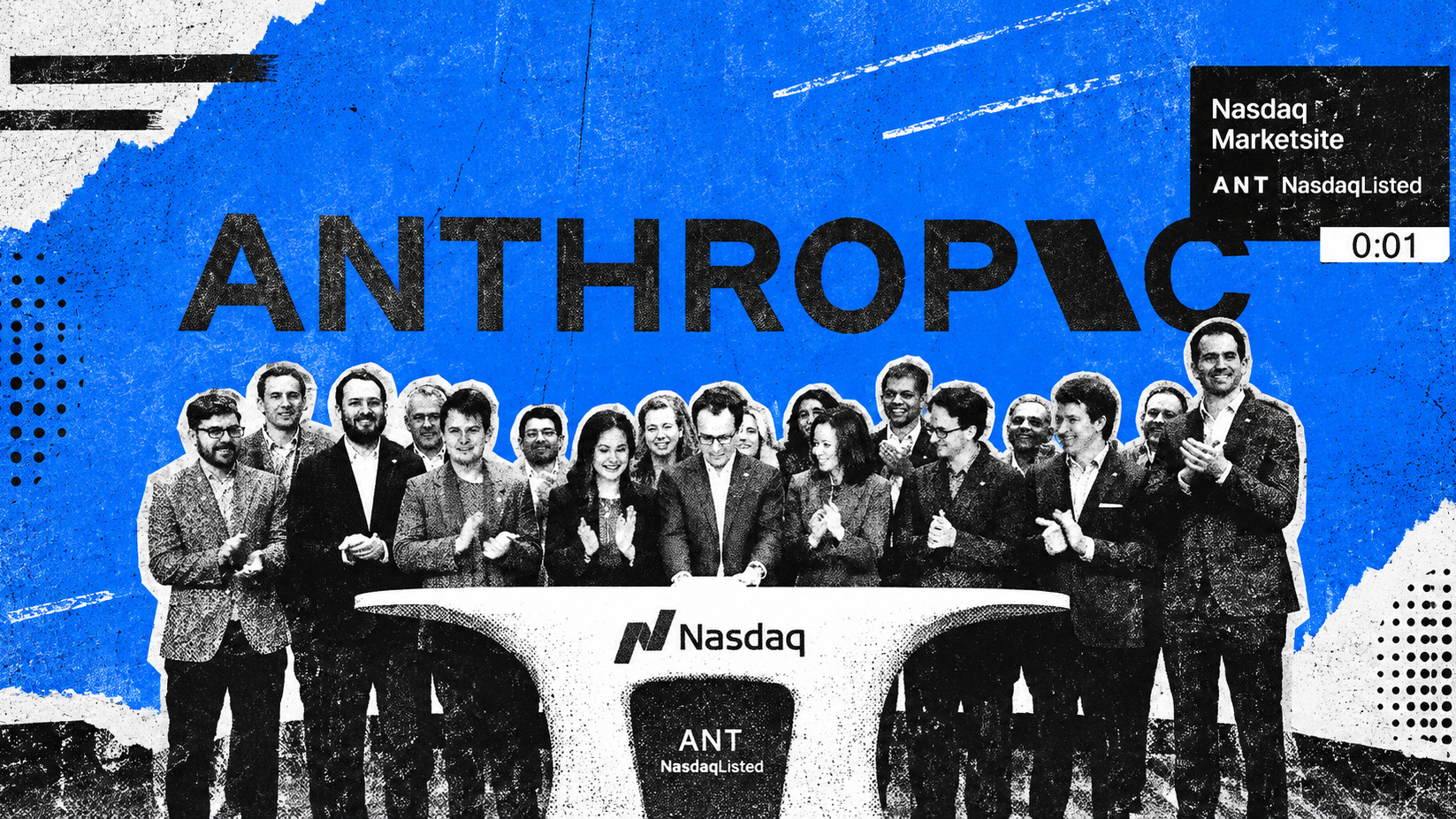



Anthropic officially landed on the Nasdaq on Thursday, marking a watershed moment for the AI industry—even as many, many questions remain.
The maker of the popular Claude chatbot, Claude Code, and enterprise-friendly AI models such as Mythos, Fable, and Opus, set a base price of $83 per share, closed up 17% at $97.17 on its first day of trading, and raised $81 billion to fund future growth.
The company's valuation is a $1.27 trillion market cap, which immediately vaults it into the top 10 most valuable companies in the US stock market, coming in the 10th spot right behind Tesla. (On a fully diluted basis, the company is worth $1.7 trillion, which would rank it 7th).
It's going to need that $81 billion to pay for the data center commitments the company has made to fund the growing number of users of its products in the years ahead. Still, Anthropic is not the money-burning furnace that other AI companies are. It reportedly turned its first operating profit in June, according to The Wall Street Journal, and has projected that it will have positive EBITDA in 2028.
The fact that Anthropic went public before its archrival, OpenAI, which has been around longer, is a testament to the fact that Anthropic has been almost solely enterprise-focused since Claude launched in 2023. And the enterprise is where the lion's share of revenue is being generated in AI today.
Despite Anthropic's successful debut on the Nasdaq, there are major questions swirling around the AI trade in the market and the course of the AI industry in general:
- Earlier this year, Anthropic's IPO was expected to reach $2 trillion at its debut. Is the discounted price a reflection of investors' wavering confidence in the future of AI?
- When OpenAI's IPO arrives in 2027, where will it land in comparison to Anthropic and is it reasonable for the two of them to be valued at the same level as tech companies that took decades to create trillions of dollars in value?
- Where will the broader AI trade go for the rest of 2026 and into 2027 now that Nvidia is in turmoil from the resignation of CEO Jensen Huang, the AI boom's No. 1 evangelist?
- The recent mid-term elections in the US were overwhelmingly won by anti-data center candidates. Will that put constraints around AI expansion across the country in the critical years to come?
- As I wrote in October at the Gartner Symposium, 81% of CIOs expect to increase AI spending in 2027 while only 11% of CFOs report that they are seeing clear returns from AI investments. Will enterprises close this gap and keep investing more resources in AI to the benefit of Anthropic and other enterprise AI vendors?
Our Deeper View
Anthropic's market debut comes at a time when AI models are commoditizing and enterprises are turning toward efficiency, with a focus on model routing and using less expensive models, small language models, and domain-specific models. Even Anthropic itself tacitly acknowledged the trend with its recent release of Fable 5.2, which builds in its own routing features that can delegate tasks to faster, lower-priced models like Sonnet and Haiku. As a result, when we think about the future of Anthropic, it's likely to be less about selling lots of metered access to enterprises for the most advanced and most expensive AI models that money can buy. Instead, think about Anthropic as the company that has created a brand around being the safest, most trustworthy, and most business-friendly AI company in the world. In the long run, that's likely to be enormously more valuable than creating the most advanced models, especially in a world that's still so distrustful of the future of AI.