


vidia is betting on robots, without actually building any robots.
On Monday, CEO Jensen Huang unveiled a flood of physical AI offerings and partnerships, spanning self-driving cars, world models, humanoids and data itself, in his keynote at the company’s annual GTC conference in San Jose. The headline? The ChatGPT moment for physical and embodied AI is here, and Nvidia wants to build its foundation.
“Physical AI has arrived — every industrial company will become a robotics company,” Huang said. “NVIDIA’s full-stack platform … is the foundation for the robotics industry.”
Here are the highlights:
- Autonomous vehicles: Nvidia announced Alpamayo 1.5, the latest iteration of the company’s platform built for “reasoning-based” autonomous vehicles. Nvidia debuted the original Alpamayo at CES in January, and since its launch, it has seen 150,000 downloads since its debut. Nvidia also unveiled Halos OS, a “safety foundation” for self-driving vehicles. Additionally, Nvidia announced a partnership with Uber to deploy its technology in robotaxis in 28 markets by 2028.
- Data pipelines: The company unveiled the Physical AI Data Factory Blueprint, its fix to the biggest bottleneck facing physical AI development. This is an architecture that automates the generation and evaluation of training data, using its Cosmos world models and coding agents to broaden and diversify limited datasets. It’s already in use by several physical AI developers, including Hexagon Robotics, Skild AI and Uber.
- Robotics: Nvidia released editions to its Cosmos world models, Isaac simulation framework and GR00T humanoid models. It also announced partnerships with more than a dozen robotics and physical AI companies, including ABB Robotics, Figure and World Labs, to support “production-scale physical AI.”
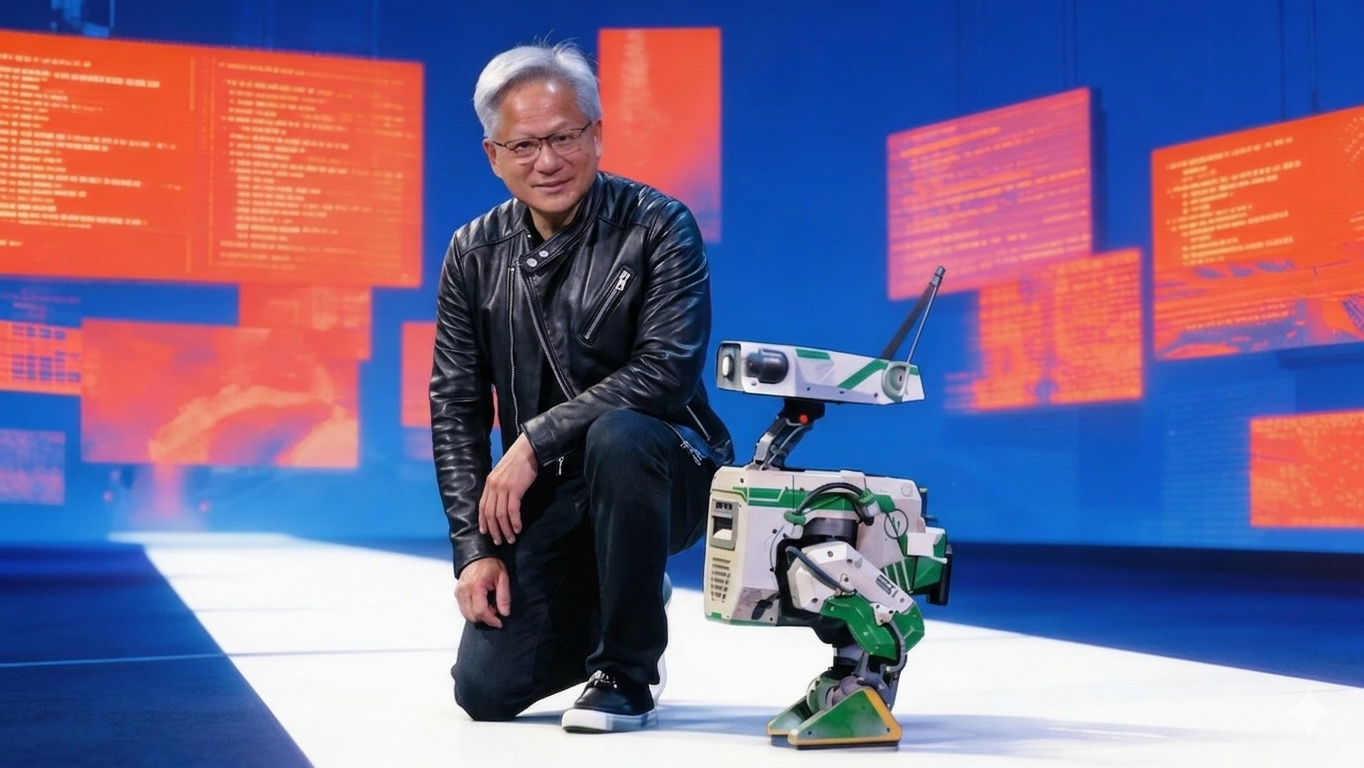
This isn’t the first time in recent history that Huang has proclaimed AI’s future lies in the real world. After a CES keynote where he was flanked by small robots that looked like they came straight out of WALL-E, Huang told reporters that the speed of development could lead to robots with human-level capabilities as soon as “next year.” Now, Nvidia is putting its money where its mouth is.
Our Deeper View
It’s hard to build a robot. Building the actual hardware that powers physical AI is resource-intensive, time-consuming and expensive. So Nvidia is doing everything but actually building them. This is a wise approach in a still-nascent market that's heavy on potential and light on products. Along with reducing upfront costs and risk, by providing the foundation for roboticists to build robots, Nvidia is making itself a foundational part of the ecosystem. Rather than competing with other physical AI hardware firms, the company positions itself as the provider of a necessary service for those firms to thrive. And of course, it's Nvidia. It positioned itself in the center of the large language model revolution, and now it’s looking to do the same for AI's next stage.